Bedding guide
Choosing an Organic Cotton Mattress Protector: Fit, Feel, and Care
A mattress protector should do its work quietly: adding a practical layer between mattress and bedding without changing the way the bed feels. To choose well, look beyond the words “organic cotton” and check the construction, pocket depth, fit, and care instructions. Here is how those details apply to the Suite Sleep organic cotton stretch-knit mattress protector.
A practical guide to materials, measurement, everyday use, and laundering.
A small layer with a meaningful job
A mattress is one of the more difficult parts of a bed to clean thoroughly. A removable protector gives it a washable barrier against ordinary dust, skin flakes, and the small marks of daily use. It can also help reduce routine wear on the mattress surface. That is a useful role, but it is important to be precise about what a protector does: unless a product is specifically described and tested as waterproof, do not assume that it will block spills or bodily fluids.
That distinction matters because “mattress protector” describes a broad category, not one universal construction. Some protectors use a waterproof membrane; others prioritize a breathable textile layer and a close, flexible fit. The Suite Sleep Organic Cotton Stretch Knit Mattress Protector is described as a fitted, stretch-knit layer made from 100% GOTS-certified organic cotton. Its stated purpose includes helping shield the mattress from dust, dirt, and everyday wear. The product information does not identify a waterproof barrier, so it is best understood as a soft textile protector rather than a substitute for a waterproof encasement.
The choice is less about finding a single best type than matching the layer to the mattress, the household, and the kind of protection needed. A guest room may call for a straightforward washable cover. A home where spills are a regular concern may need a product whose waterproof performance is clearly specified. Reading the construction details before buying can prevent a mismatch that no amount of careful fitting will fix.
What “organic cotton” tells you—and what it does not
Fiber content is a useful starting point. The Suite Sleep protector is listed as 100% GOTS-certified organic cotton, a specification that identifies the material and its certification. For a shopper who prefers natural-fiber bedding, that offers a concrete point of comparison with protectors made from synthetic fabrics or mixed materials.
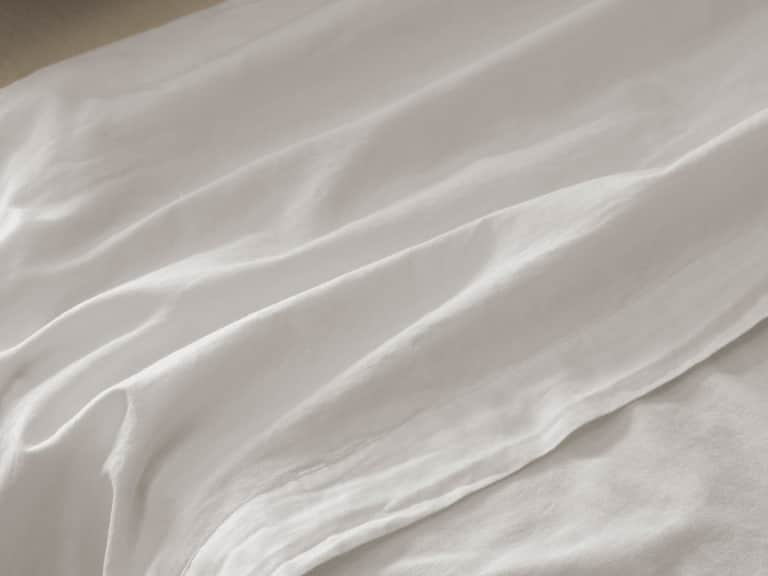
Still, a fiber label alone cannot predict everything about the finished product. How a fabric feels depends on its knit, weight, finishing, and the way it is fitted over the mattress. Cotton jersey, for example, is knitted rather than woven. Its looped structure gives it stretch, which can help a fitted protector follow the mattress surface without the taut, board-like feel some people associate with rigid covers. The product’s stretch-knit construction is therefore central to its character, not a minor detail behind the cotton claim.
Certification should be understood carefully, too. GOTS is a textile certification with defined criteria for certified products and their processing. It is not a promise that a product will suit every sleeper, feel identical to another organic cotton item, or meet a particular waterproofing standard. When comparing options, keep separate questions separate: What is the fiber? What is the construction? What does the certification cover? What kind of barrier is actually provided?
The protector’s description also notes that it is free from synthetic materials and harmful chemicals. Such claims are most useful when read alongside the stated composition and certification, rather than treated as a substitute for them. If a particular chemical, treatment, or allergy is a concern, consult the product’s current labeling and ask the manufacturer for clarification before purchase.
Measure the mattress before considering the fit
A protector can be made from an appealing fabric and still be wrong for a bed if it does not fit securely. The Suite Sleep model is described as having 18-inch-deep pockets. That measurement is an important guide, but it should not be confused with a guarantee of fit on every mattress described as “18 inches.” Mattress shapes, corner construction, toppers, and the protector’s own cut all affect how the finished layer sits.
Measure the mattress from its lowest point at the side to its highest point at the top. Include any topper or permanent mattress pad that will remain under the protector. Do not include a pillow or loose comforter. Check the measurement at more than one side if the mattress is uneven, then compare the result with the protector’s stated pocket depth. A little allowance can help the fitted corners stretch into place; a protector that is too shallow may pull up or creep off during the night.
Before ordering, confirm the mattress length and width as well as its depth. “Queen” or “King” is not always enough information when a bed has an unusual profile or adjustable base. A protector should match the actual mattress dimensions, and split or specialty configurations may require a product designed for that format. The Suite Sleep description highlights deep 18-inch pockets and a fitted style, but it does not establish compatibility with every bed size or adjustable-bed setup; check the available sizing details for the exact version being considered.
After fitting, look for an even surface without pronounced tension across the corners. The protector should lie flat rather than form ridges beneath the sheet. If the mattress has a thick pillow top or a topper, confirm that both the protector and the fitted sheet can accommodate the combined depth. A well-fitted protector should not require forceful stretching, and its elasticized edge should remain beneath the mattress rather than riding upward.
- Measure the mattress’s width, length, and depth at the deepest point.
- Include a topper if it will sit beneath the protector.
- Compare the measurement with the listed pocket depth, not just the bed-size name.
- Check the finished fit at all four corners after installation.
How stretch knit affects the feel of a bed
A protector is only one layer in a system. It sits between the mattress and the fitted sheet, where a rough, noisy, or overly taut cover can make itself known. A stretch-knit cotton surface is intended to move with the bed rather than act like a rigid shell. The Suite Sleep design is described as conforming to the mattress while preserving its natural feel and avoiding added bulk or stiffness.
That description is a useful expectation, not a guarantee that every sleeper will perceive the layer in the same way. Mattress firmness, the sheet fabric, room temperature, and personal sensitivity all contribute to the experience. If a bed already feels warm, remember that the overall sleep system includes the mattress, protector, fitted sheet, blankets, and the sleeper’s own environment. A cotton surface may be breathable, but it cannot by itself regulate temperature in every room or compensate for heavy bedding.
There is also a practical difference between “stretch” and “slack.” Stretch helps a fitted protector adapt to the mattress and may reduce bunching when it is sized correctly. But too much tension can pull the corners out of place; too much excess fabric can gather beneath the sheet. Correct dimensions and a careful fit matter as much as the fabric’s flexibility.
For shoppers comparing cotton protectors with waterproof designs, consider the trade-off in intended function. A textile layer may prioritize a natural-fiber feel and a simple washable construction. A waterproof model may include a membrane or coating, with a different hand and care routine. Neither description automatically makes one universally superior. The appropriate choice depends on whether the priority is everyday surface protection, liquid resistance, or both—and on how clearly the manufacturer documents those capabilities.
The Suite Sleep protector at a glance
The product details give shoppers a concise set of specifications to verify against their own needs. They describe a fitted stretch-knit mattress protector made from 100% GOTS-certified organic cotton, with 18-inch pockets. The fabric is intended to conform to the mattress and preserve its feel, and the care guidance recommends washing before use. The listed washing advice is to use a cold or warm cycle with non-toxic detergent, avoid bleach and fabric softener, and machine-dry on low to medium heat.
That is a relatively straightforward routine, but laundering remains part of the product decision. If your household relies on a particular detergent or high-temperature wash, check the current care label before purchase. The product information also says the protector is pre-shrunk while recommending that it be washed before use. Follow the care label and allow for the maker’s specified process rather than assuming that every cotton textile can be treated the same way.
For the complete listed specifications, see the Suite Sleep Organic Cotton Stretch Knit Mattress Protector. Confirm sizing, care, and current product details at the point of purchase; product specifications can change, and the exact variant available may affect the fit.
Care that protects the fabric and keeps the routine simple
Frequent washing can gradually affect any textile, so a useful mattress protector is one whose care requirements fit real life. For the Suite Sleep option, the stated instructions recommend washing before first use, using a cold or warm cycle, choosing a non-toxic detergent, and avoiding both bleach and fabric softener. The product guidance calls for machine drying on low to medium heat.
Bleach may be harsh on fibers and can affect color or fabric integrity. Fabric softener can leave a coating on textiles, which is one reason the product instructions say not to use it. A mild detergent and a suitable cycle are the simpler route. Wash the protector according to its own care label rather than applying the rules for sheets, towels, or other cotton items automatically.
It is sensible to avoid overloading the washer. A protector needs room to circulate and rinse; a tightly packed drum can leave detergent behind or make it harder for the load to move freely. If laundering with other items, choose pieces with compatible colors and care requirements. Remove the protector from the dryer when the cycle ends, check that it is fully dry, and smooth it before putting it back on the bed. Do not use a hotter setting or an unapproved treatment simply to speed up the process.
Frequency depends on household circumstances. A protector may need washing more often after a spill or when someone has been ill, while routine laundering can follow the household’s normal bedding schedule and the manufacturer’s instructions. There is no single interval that suits every home. The useful principle is to wash when needed, follow the care label, and make sure the layer is dry before it goes back over the mattress.
- Wash before first use, as the product guidance recommends.
- Use a cold or warm wash cycle and detergent appropriate to the care label.
- Do not use bleach or fabric softener on this protector.
- Machine-dry on low to medium heat, then ensure the fabric is completely dry.
- Recheck the fit after laundering and smooth out any shifted corners.
Common buying mistakes to avoid
The first is treating “organic cotton” as a full description of performance. It identifies a fiber and, in this case, a stated certification; it does not tell you pocket depth, fit, waterproofing, or washability. Those details need their own checks.
The second is measuring only the mattress size printed on a tag. A topper can add height, and a deep mattress may exceed the capacity of a standard fitted design. Measure the assembled sleep surface and compare it with the listed pocket depth. If the measurement is close to the stated limit, ask the seller or maker to confirm the fit rather than guessing.
The third is expecting a protector to solve every bedding problem. It is not a mattress topper, a mattress pad, or necessarily a liquid barrier. A protector can shield a mattress from some everyday dust and wear, but its function depends on construction. If spill protection is essential, look for an explicit waterproof specification and relevant care guidance.
Finally, do not overlook laundry instructions. A product that feels appealing but requires care your household cannot realistically follow may not be the most practical choice. In this case, the listed routine is machine washing and drying within specified temperature limits, with bleach and fabric softener avoided. That is simple enough for many households, provided the care label is followed.
A quick decision checklist
Before choosing an organic cotton mattress protector, pause over a few basic questions. They turn a broad product description into a decision grounded in the actual bed.
- What protection do you need? Distinguish everyday dust and wear from liquid resistance, which requires a clearly specified waterproof construction.
- What is the full mattress depth? Include any topper that will remain beneath the protector.
- Does the pocket depth suit the bed? The Suite Sleep protector is listed with 18-inch pockets; compare that with your measured setup.
- What is the fabric and construction? This option is described as 100% GOTS-certified organic cotton in a stretch-knit fitted design.
- Can you follow the care instructions? The listed guidance calls for washing before use, avoiding bleach and fabric softener, and using low-to-medium dryer heat.
- Does the finished bed still feel right? A correctly sized layer should lie smooth beneath the fitted sheet without obvious bunching or excessive tension.
A considered choice, not a complicated one
A mattress protector is easy to overlook because, when it fits well, it disappears beneath the sheet. That is precisely why the specifications deserve attention before buying. Fiber content speaks to what the textile is made from; knit construction helps explain how it stretches and feels; pocket depth is a practical measure of compatibility; care instructions determine whether it can be maintained without guesswork.
The Suite Sleep organic cotton stretch-knit protector brings those considerations together in a simple format: certified organic cotton, a fitted construction, and 18-inch pockets. Its care guidance is equally specific, with washing before use, no bleach or fabric softener, and low-to-medium machine drying. Measure first, confirm the exact size, and be clear about whether you need a textile barrier or waterproof protection.
Those checks are not glamorous. They are the difference between a layer that quietly does its job and one that shifts, bunches, or proves ill-suited to the bed. In a room built around rest, the best practical detail is often the one that stays out of sight—and stays in place.